Chapter 2.2
Celestial Sphere
Celestial Poles
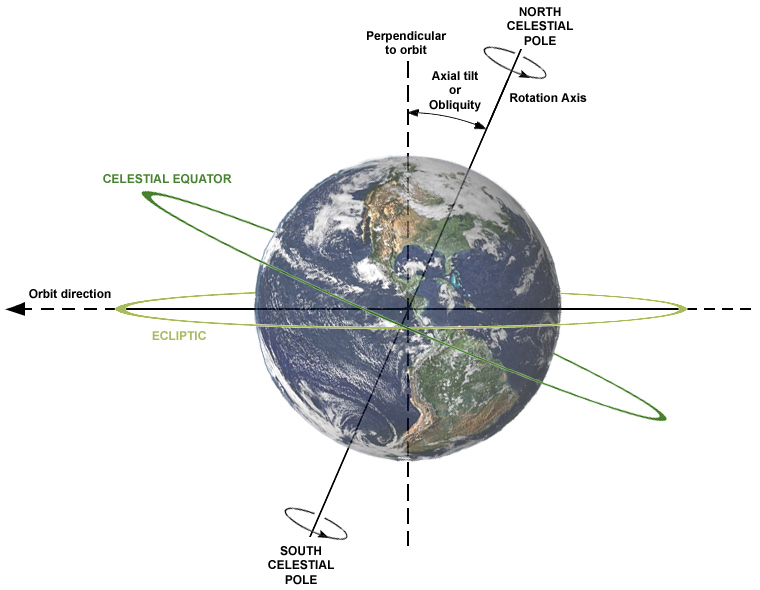
The north and south celestial poles are the two points in the sky where Earth's axis of rotation,
indefinitely extended, intersects the celestial sphere. The north and south celestial poles appear
permanently directly overhead to observers at Earth's North Pole and South Pole, respectively.
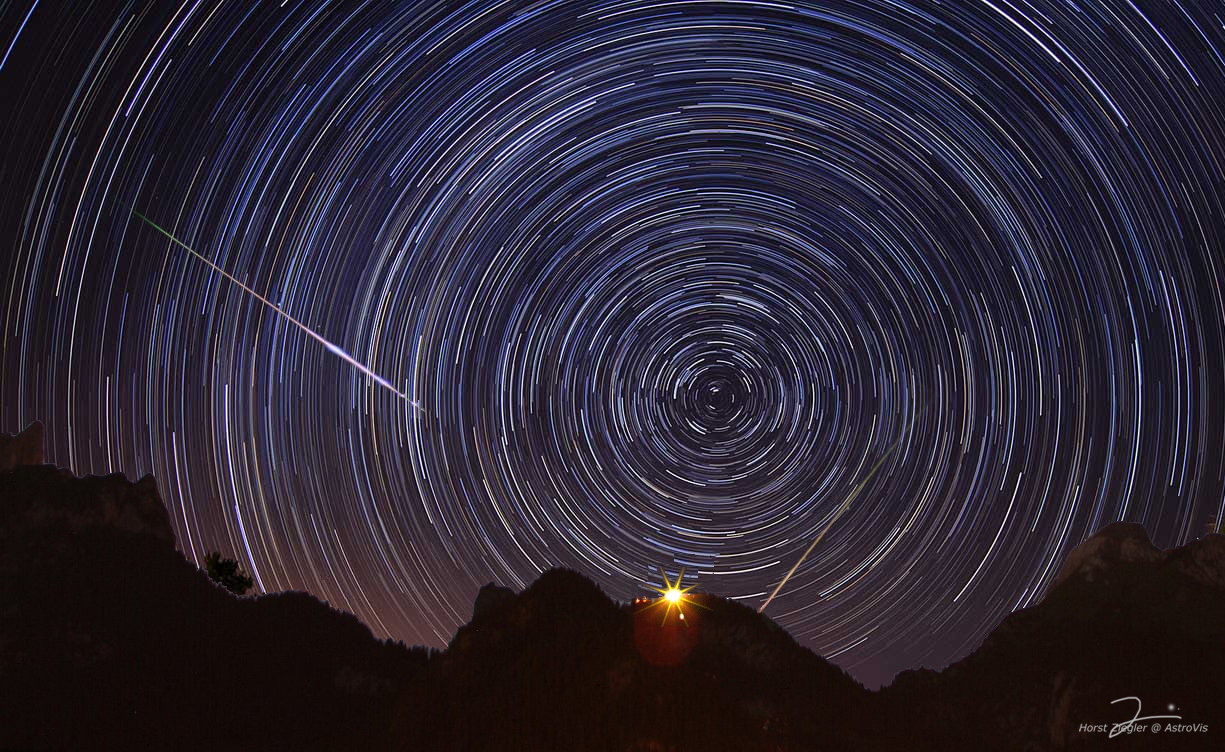
Polaris is located quite close to the point in the sky where the north rotational axis points - a spot
called the north celestial pole. As our planet rotates through the night, the stars around the pole
appear to rotate around the sky.
|
|
Relation between Longitude, Latitude, RA and DEC
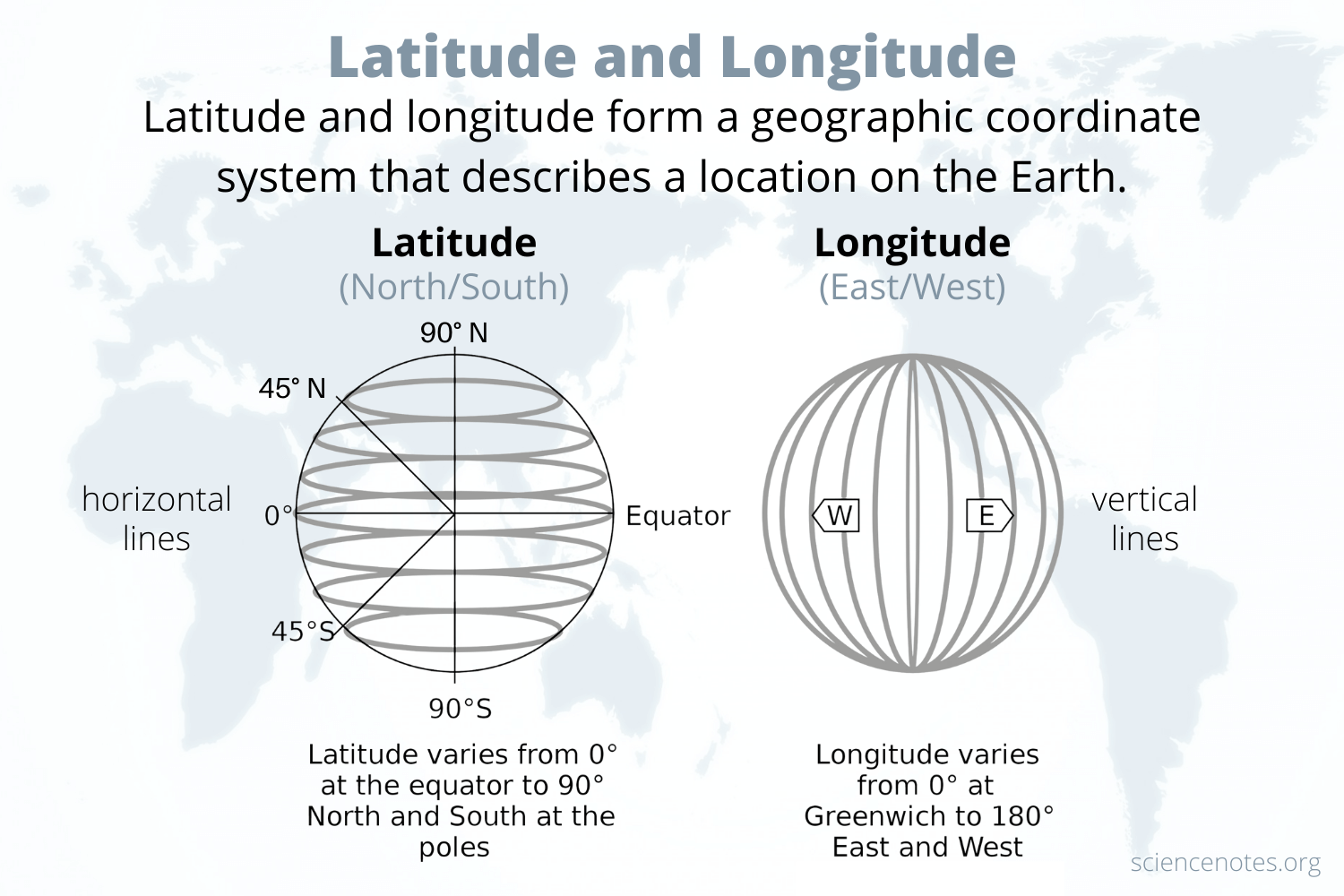
RA (right ascension) and Dec (declination) are the coordinates on the sky that correspond to longitude and latitude on
Earth. RA measures east and west on the celestial sphere and is like longitude on the Earth. Dec measures north and
south on the celestial sphere and is like latitude on the Earth.
Three earthly coordinates determine where an earthbound telescope must be pointed to view an astronomical object:
latitude, longitude, and time.
Two additional astronomical coordinates, declination and right ascension, determine where the object appears on the
virtual "celestial sphere."
For objects in motion on the celestial sphere (like planets, asteroids or satellites), time also is used to fix
location.
So with those five coordinates (lat, long, dec, RA, and time), you (or a computer) can calculate the altitude
(height above the horizon) and azimuth (compass direction) to an object and point a telescope accordingly.
|
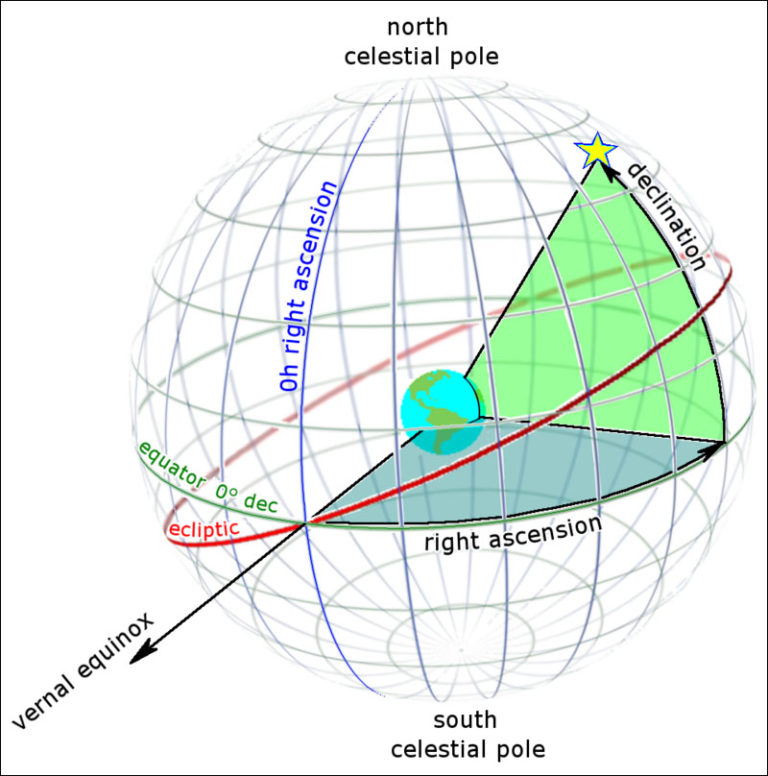
Here's Earth inside the big soccer ball. Declination (green) is measured in degrees north and south of the celestial equator. Right ascension, akin to longitude, is measured east from the equinox. The red circle is the Sun's apparent path around the sky, which defines the ecliptic.
Tom Ruen / CC BY-SA 3.0
|
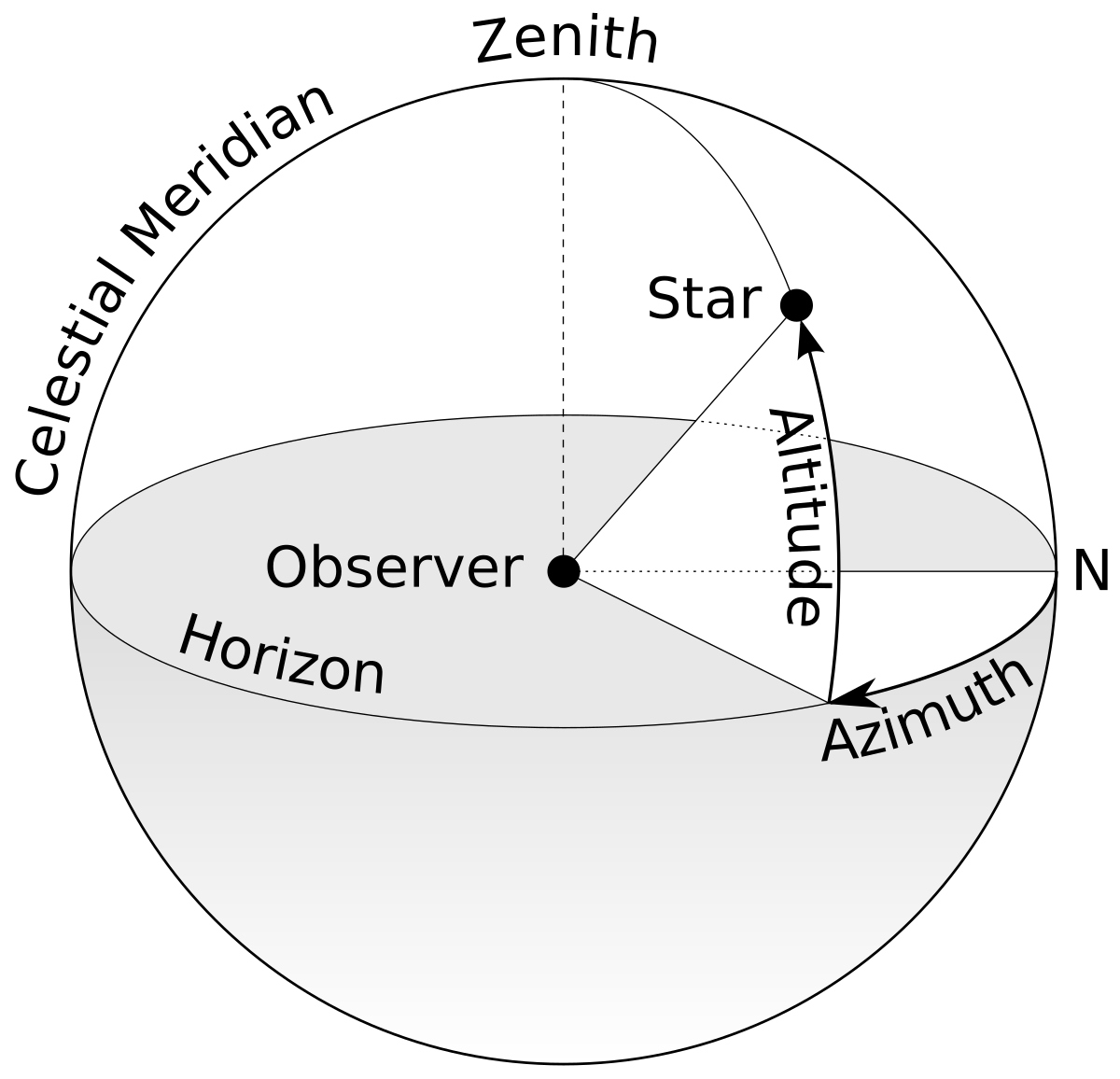
Altitude & Azimuth
Altitude, sometimes referred to as elevation (el.) or apparent height, is the angle between the object and the
observer's local horizon. For visible objects, it is an angle between 0° and 90°. Azimuth is the angle of the
object around the horizon, usually measured from true north and increasing eastward.
|
|
Constellations
A constellation is a grouping of stars that represents one of the 88 divisions of the celestial sphere as defined
by the International Astronomical Union. Many constellations are derived from old traditional asterisms, which
are star patterns within a constellation.
The constellations you can see at night depend on the time of year. Earth orbits around the Sun once each year.
Our view into space through the night sky changes as we orbit.
It can be a little confusing to picture how the night sky changes as we orbit the Sun. You can see how it all
works in the illustration on the right side.
For example, say you are in the Northern Hemisphere looking into the night sky on September 21. You will
probably be able to see the constellation Pisces. But you won't see Virgo because that constellation is on the
other side of the Sun. During that time of year, Virgo's stars would only be visible during the daytime - but
you'd never see them because of the brightness of our Sun.
|
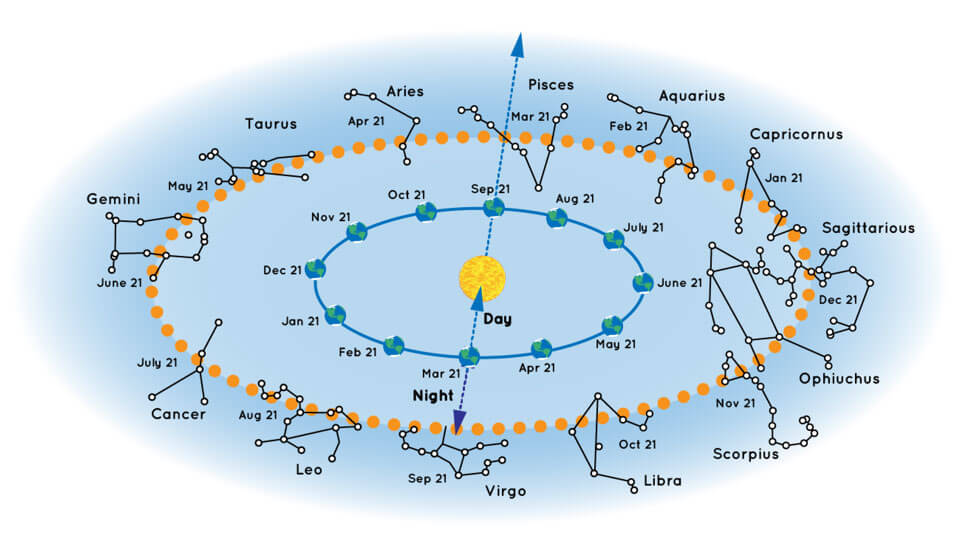
A chart showing some of the constellations that are visible from the Northern Hemisphere in different times of year.
Credit: NASA/JPL-Caltech
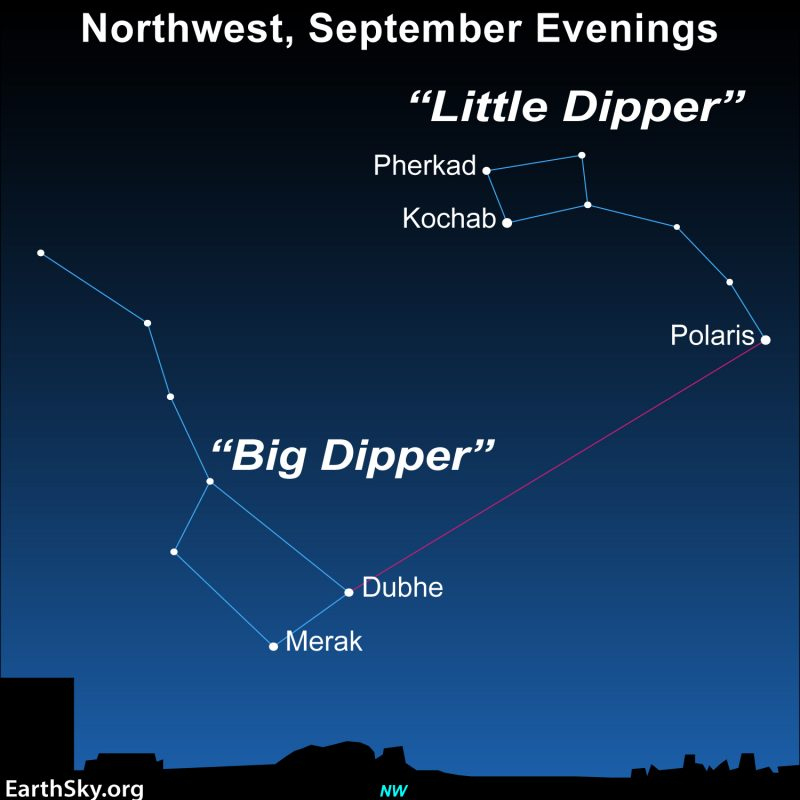
Locating Polaris is easy on any clear night. Just find the Big Dipper. The two stars on the end of the Dipper's "cup"
point the way to Polaris, which is the tip of the handle of the Little Dipper, or the tail of the little bear in
the constellation Ursa Minor
|
|
|
