
Implications of under-/over-sampling:
undersampling reduces the influence of guiding errors and improves signal to noise at the expense of finest detail
oversampling will require a good mount and careful guiding. OK for high magnification solar, lunar or planetary imaging.
Might cause signal to noise issues with wide-field imaging
It is important to find a good balance between over- and undersampling. Namely so, that the camera still
works as sensitive as possible, but the images are good shaded. The following figure illustrates graphically
this relationship.
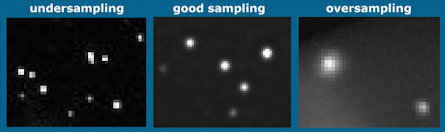
On the left the undersampling shows almost only square stars. On the right oversampling shows many shades of gray,
but the light of the stars is smeared over many pixels.
Center of the picture is an example of good sampling.
For deep sky imaging, the rule of thumb for the image scale is to achieve a value of about 1.5 arcsecs to 2 arcsecs per pixel.
In this rule of thumb, the normal local seeing should be included. The seeing value is simply divided by
2.67 (low) or 2 (high) if you have local seeing on average of 4 arcseconds.

 Seeing-Values
1 = FWHM 0-1 Dream
2 = FWHM 1-2 Perfect
3 = FWHM 2-3 Very good
4 = FWHM 3-4 Good
5 = FWHM 4-5 Average
6 = FWHM 5-6 Average
7 = FWHM 6-7 Moderate
8 = FWHM 7-8 Bad
9 = FWHM 8-9 Very bad
10 = FWHM 9-10 Unusable
|